
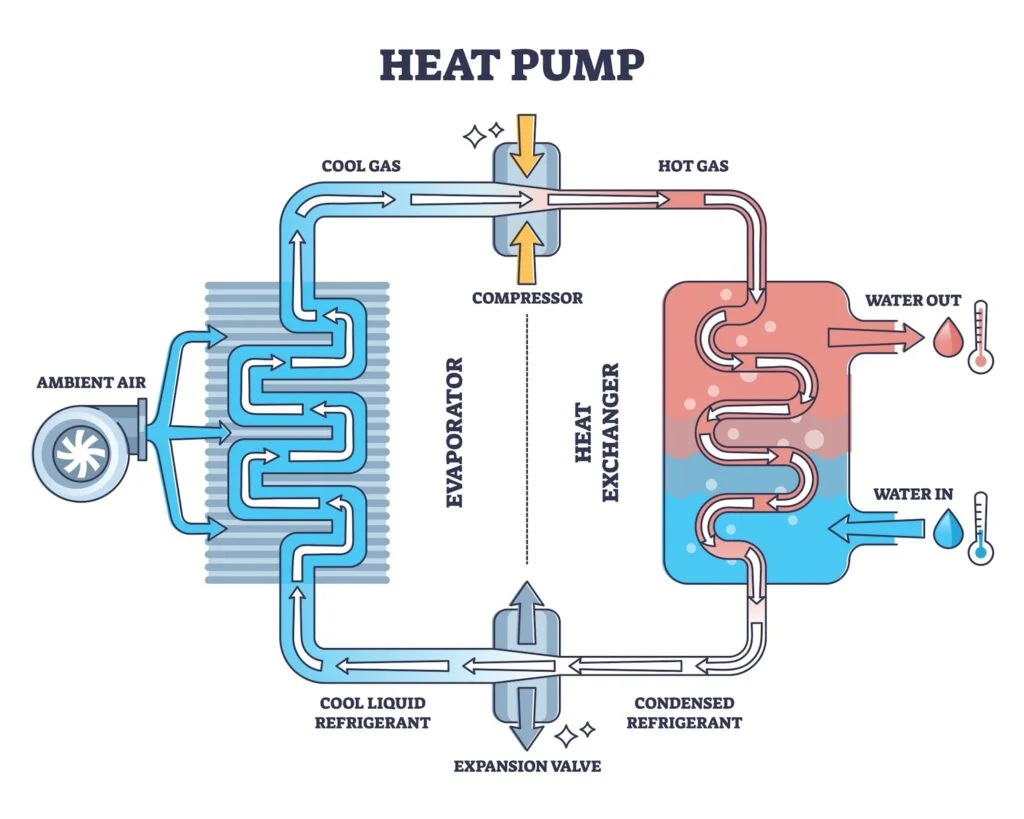
A heat pump works by transferring heat rather than creating it. In the summer, it acts like an AC, pulling heat from your home and venting it outside. In the winter, a reversing valve switches the flow of refrigerant, allowing the system to extract heat from the outdoor air and move it indoors.
The “One-Device” Mystery: Cooling and Heating Explained
We’ve all experienced that classic Houston weather whiplash. One morning you’re running the AC because it’s a humid 85°F, and by nightfall, a “Blue Norther” has blown in, leaving you shivering in the 40s. Traditionally, Houstonians relied on two separate systems: an air conditioner for the 10-month summer and a gas furnace for the 2-month winter.
But what if one machine could handle both—more efficiently than either? If you’re asking how does a heat pump work, you’re likely looking for a way to simplify your home maintenance and slash those climbing energy bills. At Valderrama A/C & Refrigeration, we’ve seen heat pumps become the gold standard for Southeast Texas living.
5 Signs You Should Switch to a Heat Pump
If your current setup is showing these signs, it might be time to move beyond the traditional furnace/AC combo:
- Astronomical Summer Light Bills: Your old AC is struggling to keep up with the “latent heat” (humidity).
- Frequent Furnace Repairs: Your gas heater is over 12 years old and becoming a safety concern.
- Uneven Temperatures: You have hot and cold spots throughout your home.
- A Desire for Dehumidification: You want a system that pulls more moisture out of the air.
- Limited Space: You want to reclaim space in your attic or closet by removing a bulky furnace.
The Science of Transfer: How Does a Heat Pump Work?
The most important thing to understand is that a heat pump doesn’t “make” cold or heat; it moves it. Think of it like a sponge that can soak up heat in one place and squeeze it out in another.
The Cooling Cycle (Summer Mode)
During a brutal July afternoon in the Energy Corridor, your heat pump works exactly like a standard air conditioner.
- Absorption: The indoor evaporator coil uses cold refrigerant to “soak up” the heat and humidity inside your home.
- Transportation: The refrigerant carries that heat through copper lines to the outdoor unit.
- Release: The outdoor compressor squeezes the refrigerant, and a fan blows the collected heat into the Texas air.
- Repeat: The now-chilled refrigerant heads back inside to grab more heat.
The Heating Cycle (Winter Mode)
This is where the magic happens. When the temperature drops, a component called a reversing valve flips the direction of the refrigerant.
- Extraction: Even when it feels cold outside (say, 40°F), there is still a massive amount of ambient heat in the air. The outdoor unit “soaks up” this heat.
- Compression: The system compresses the refrigerant, which causes its temperature to skyrocket.
- Release: This intense heat is carried inside to your vents, warming your home without burning a single drop of natural gas.
The Houston Advantage: Why Heat Pumps Win in Texas
While heat pumps struggle in the frozen tundra of the North, they are perfectly suited for the Greater Houston area.
Mastering the Humidity
In Houston, our comfort is dictated by the “feels like” temperature. Heat pumps are exceptionally good at removing humidity. Modern variable-speed heat pumps run at lower, steadier speeds, which allows them to pull more water vapor out of the air than a traditional “on/off” AC unit.
Survival During the Freeze
Since Houston rarely stays below freezing for extended periods, a heat pump operates at peak efficiency (often 300% to 400% efficiency) for almost the entire winter. For those rare record-breaking freezes, we often install “auxiliary heat strips” or a dual-fuel system that provides a backup boost when you need it most.
Why Professional Design Matters
Understanding how does a heat pump work is only half the battle; the other half is ensuring it’s installed correctly for the specific layout of your home.
A “cookie-cutter” installation can lead to a system that is too large (which won’t dehumidify) or too small (which will run 24/7). At Valderrama A/C & Refrigeration, we perform a full “Manual J” load calculation. We look at your window directions, insulation levels, and even the local tree canopy to ensure your heat pump is perfectly sized for your specific slice of Houston.
DIY Maintenance: Keeping the Cycle Moving
Because heat pumps work year-round, they need a little more love than a system that sits idle half the year.
- The 30-Day Filter Rule: A clogged filter chokes the heat transfer process. Change yours monthly.
- Clear the Perimeter: Keep at least two feet of clear space around your outdoor unit. Houston’s fast-growing weeds and shrubs can quickly block the airflow.
- Rinse the Coils: Gently spray your outdoor unit with a garden hose to remove salt air residue and dust.
If you notice your system struggling to switch modes or making strange “shuddering” noises, it’s best to consult a professional for high-efficiency heat pump services before a minor glitch becomes a major repair.
FAQ: Common Heat Pump Questions
Q: Is a heat pump more expensive to run than a gas furnace?
A: In Houston, heat pumps are typically much cheaper to run during our mild winters. Electricity is often more stable than gas prices, and the efficiency of moving heat is far superior to creating it through combustion.
Q: Do heat pumps last as long as traditional ACs?
A: Because they run year-round, they can experience more wear. However, with bi-annual maintenance, a high-quality heat pump can easily last 15 years.
Q: Why does my heat pump blow “lukewarm” air compared to my old furnace?
A: A gas furnace blows very hot air (120°F+), which can feel dry and harsh. A heat pump produces air around 90-100°F. It’s plenty warm to heat your house, but it feels more natural and less “scorching” to the touch.
Q: Can I use a smart thermostat with a heat pump?
A: Yes! In fact, we recommend it. A smart thermostat can manage your “auxiliary heat” settings to ensure you aren’t using expensive backup heat unless it’s absolutely necessary.
Q: What happens if the outdoor unit freezes in the winter?
A: Don’t panic! Heat pumps have a built-in defrost cycle. The unit will occasionally reverse itself for a few minutes to melt any ice buildup.
Ready to Upgrade Your Home’s IQ?
Now that you know how does a heat pump work, are you ready to see what one can do for your utility bills? At Valderrama A/C & Refrigeration, we specialize in helping Houston homeowners transition to the future of home comfort. We provide transparent pricing, expert installation, and the local knowledge required to survive a Texas summer.
Want to see if a heat pump is right for your home?
Schedule your Heat Pump Consultation and Efficiency Audit!
Call us today at (281) 974 – 4599 to learn about 2026 energy rebates!