
If you are asking how much is an ac unit installed in the Houston area, the total investment typically ranges from $5,200 to $13,500. Standard single-stage systems cost between $4,800 and $7,200, while premium high-efficiency variable-speed units paired with matched evaporator coils range from $9,500 to $16,000+.
When the Heat Turns Your Home into an Oven
It is 3:00 PM on a sweltering Tuesday afternoon. Outside, ambient temperatures are hovering near 99°F with a heat index that feels closer to 112°F. Inside your living room, the digital thermostat is stuck at 83°F. You walk outside to the patio pad, only to find the condenser fan stopped cold, humming faintly as it gives off a sharp electrical odor.
A diagnostic check confirms the dreaded news: the compressor is dead, your coils have corroded, and your 13-year-old system is finished.
Now comes the stressful part: figuring out what replacement really costs. You call a few companies. One gives you a ballpark figure of $5,000 over the phone without seeing your house. Another hands you a glossy estimate for $18,000 with confusing line items.
Understanding how much is an ac unit should not feel like a guessing game. Equipment pricing depends on real engineering variables—including system tonnage, efficiency ratings, duct static pressure, and labor standards. At Valderrama A/C & Refrigeration, we believe in complete financial transparency. Here is a clear, realistic breakdown of what a new central air conditioning system costs in our market.
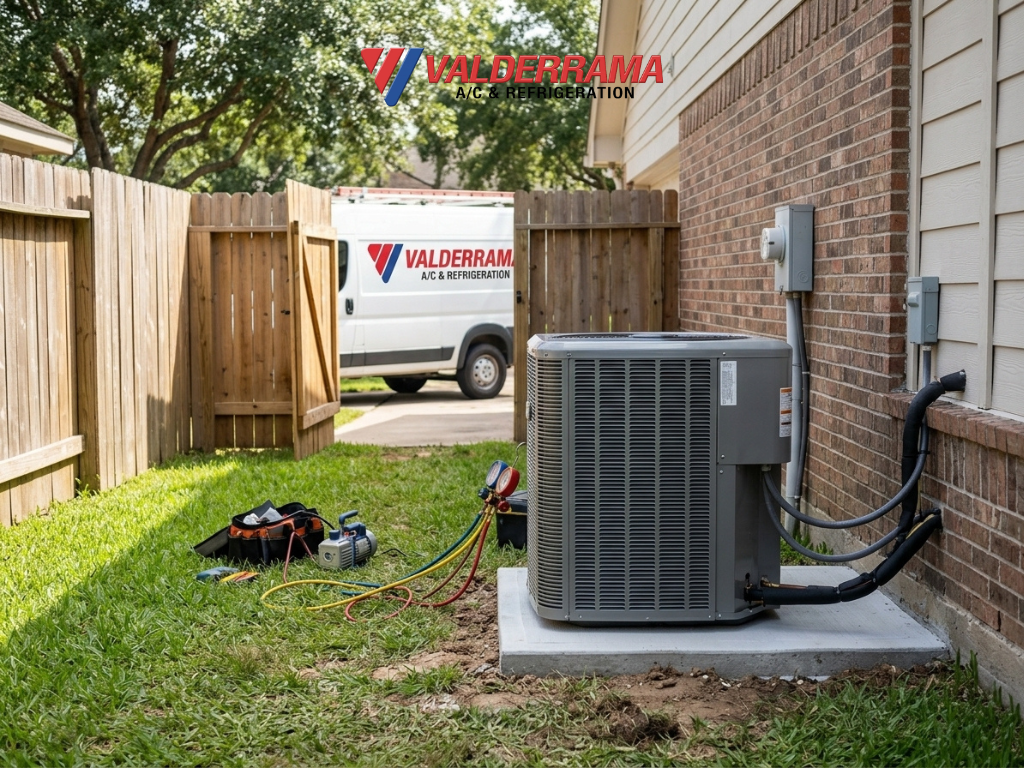
The Houston Factor: Why Local Climate Drives Equipment Pricing
Buying an air conditioning unit in Southeast Texas involves demands that homeowners in drier or cooler states never encounter.
Houston’s heat and humidity place extreme strain on AC systems. Because our local cooling season frequently stretches across ten months of the year, a central air conditioning unit here logs double or triple the annual running hours of a system in the Midwest.
Our dense coastal climate introduces a massive “latent heat load.” Your air conditioner cannot focus solely on dropping the temperature reading on your wall; it must also wring hundreds of gallons of raw liquid water vapor out of your indoor air every single week.
If you buy a cheap, undersized, or improperly balanced unit, the equipment will run non-stop under high internal head pressure, driving up electric bills and causing the compressor to fail early. Conversely, an oversized unit will cool the house too fast without dehumidifying, leaving your rooms cold, damp, and clammy. Investing in a properly matched system engineered for high humidity pays for itself in reliability and comfort.
5 Signs You Need Air Conditioning Replacement Right Now
Before your system completely gives out during a dangerous triple-digit heatwave, watch for these five warning signs that replacement is your smartest financial move:
- The Unit Is Over 10 to 12 Years Old: Central air systems in demanding southern climates typically reach the end of their design life after a decade of heavy use.
- Repairs Cost More Than Half the System’s Value: Following the industry standard, if a repair quote approaches 50% of the cost of a modern replacement, replacing the unit is the more sensible investment.
- The Equipment Still Uses Banned R-22 Freon: Units built before 2010 run on phased-out refrigerant, making simple leak repairs and recharges cost-prohibitive.
- Persistent High Indoor Humidity: The thermostat displays your target temperature, but the air feels sticky, damp, and heavy throughout the house.
- Rising Electric Bills Under Similar Weather: Your monthly energy statements show a steady, unexplained upward climb compared to previous seasons.
If your aging equipment is displaying these breakdown signs right now, explore our full lineup of air conditioning services to see how modern, high-efficiency systems restore quiet, reliable cooling.
What Determines the Real Cost of an AC Unit?
The final price of a central cooling installation breaks down into four primary mechanical tiers:
- Standard Single-Stage Systems (14.3 to 15.2 SEER2): These units run at 100% capacity whenever they turn on. They offer the lowest upfront investment—typically $4,800 to $7,200 installed—and are well-suited for rental properties, budget-conscious updates, or milder use.
- High-Efficiency Two-Stage Systems (16 to 17.5 SEER2): These units operate on a low speed (around 65% capacity) during mild weather and kick into high gear during peak afternoon heat. They cost between $7,500 and $10,800 installed, providing balanced energy savings and noticeably better dehumidification.
- Ultra-Efficient Variable-Speed Systems (18 to 22+ SEER2): Using advanced inverter compressors, these systems modulate output in small increments between 25% and 100% capacity. They cost between $11,000 and $16,000+ installed, delivering quiet operation, flat temperature control, and the lowest monthly power bills.
- System Sizing and Capacity (Tonnage): Sizing typically ranges from 2 to 5 tons for residential homes. A larger 4- or 5-ton system requires larger copper lines, higher electrical capacity, and a larger condenser, adding $1,000 to $2,500 compared to a smaller 2- or 2.5-ton unit.
Why Professional Service Matters: The Hidden Costs of Cheap Labor
An air conditioner is not an appliance you simply plug into a wall outlet. More than 80% of an air conditioner’s efficiency, cooling capacity, and operational lifespan depends directly on how the physical installation is handled.
- Factory Warranty Requirements: Leading equipment manufacturers strictly mandate that systems be installed by a licensed HVAC contractor. Hiring an uncertified handyman will immediately void your 10-year parts warranty.
- Refrigerant Line Evacuation: Modern refrigerants and synthetic oils operate under tight tolerances. If an uncertified installer fails to pull a deep vacuum below 500 microns, airborne moisture stays trapped inside the copper lines, forming acid that eats through the compressor windings.
- Ductwork Static Pressure Testing: Installing a brand-new, high-efficiency condenser onto leaky, crushed, or undersized flexible ductwork chokes airflow, creates static pressure bottlenecks, and wastes up to 30% of your conditioned air.
- Municipal Permitting and Safety: In Texas, major HVAC replacements require city permits and official mechanical inspections to ensure electrical circuits, disconnect boxes, and drain pan float switches are installed to code.
Why Choose Valderrama A/C & Refrigeration?
Investing in a new central air conditioning system is a major financial decision. When you choose our family-owned team, you receive:
- Transparent, Fixed-Price Quotes: We provide detailed, itemized estimates before turning a wrench—no surprise change orders, hidden trip fees, or aggressive sales tactics.
- Licensed Texas Mechanical Specialists: Our technicians hold active TDLR licenses, carry full commercial insurance, and receive regular training on modern variable-speed equipment and updated SEER2 building codes.
- Flexible Financing Opportunities: We partner with trusted lending platforms to offer flexible payment plans, low monthly options, and competitive interest rates to keep your cash reserves intact.
- Turnkey Installation Standards: We handle everything—from running software-based Manual J load calculations and pulling municipal permits to balancing ductwork and hauling away your old hardware.
If you are ready to compare exact system options tailored to your home’s layout, reach out through our contact page to book an on-site consultation.
Frequently Asked Questions About AC Unit Costs
Q: Can I replace just the outdoor AC condenser and keep my old indoor coil?
A: We strongly advise against this. Air conditioners operate as matched thermodynamic systems. Connecting a new outdoor condenser to an old, mismatched indoor evaporator coil lowers overall efficiency, creates static pressure imbalances, and usually voids the manufacturer’s warranty.
Q: How much can a modern high-efficiency AC unit save me on my electric bills?
A: Upgrading an old 10- or 12-SEER unit to a modern 16+ SEER2 system can lower your cooling-related electricity consumption by up to 25% to 40%, delivering noticeable monthly savings throughout our long summer cooling seasons.
Q: Are there tax credits or utility rebates available for new AC units?
A: Yes. Many high-efficiency systems and modern heat pumps qualify for federal energy tax credits, along with instant cash-back rebates from local electric utilities for installing qualifying high-SEER2 equipment.
Q: How long does a full AC replacement take to install?
A: For a standard residential replacement where existing ductwork is structurally sound, our expert field crews typically complete the removal, copper brazing, vacuum evacuation, and system commissioning within 6 to 10 hours.
Q: What size AC unit does my home need?
A: Sizing should never be based solely on square footage. Proper sizing requires an ACCA Manual J load calculation, which factors in your home’s window orientation, insulation levels, ceiling heights, and air leakage to determine the exact cooling capacity required.
Get Clear, Honest Pricing for Your Home’s Cooling Today
You do not have to put up with an unreliable air conditioner, high electric bills, or unclear contractor estimates. Knowing how much is an ac unit gives you the confidence to choose the right equipment, protect your budget, and keep your home comfortable through the hottest Texas summers.
At Valderrama A/C & Refrigeration, we take pride in delivering honest evaluations, skilled mechanical craftsmanship, and dependable service across the Greater Houston area.
Ready to find the ideal cooling system for your home and budget?
Schedule Your Free, Upfront AC Replacement Estimate Today!
Call our local office directly at (281) 974 – 4599 to speak with an experienced specialist and confirm your consultation!