
The lifespan of commercial HVAC systems varies significantly by equipment type, installation quality, operating hours, maintenance, building conditions, and climate. Many commercial HVAC systems can provide roughly 15 to 20 years of service, while individual equipment such as chillers, boilers, and well-maintained systems may have different service-life expectations. In Texas, intense summer heat, high humidity, long operating seasons, and coastal exposure can increase equipment stress. Regular preventive maintenance and timely repairs can help businesses maximize useful service life and plan replacement before an unexpected failure.
For a business owner or facility manager, HVAC lifespan isn’t simply about how many years a unit has been installed.
A 12-year-old rooftop unit with excellent maintenance records may be more reliable than a poorly maintained 8-year-old system. Likewise, an older system that still operates may no longer be the most economical equipment to keep running if repairs, energy consumption, and downtime are increasing.
Understanding the lifespan of commercial HVAC systems helps facility managers make better decisions about maintenance, budgeting, capital improvements, and equipment replacement.
The “Monday Morning” Asset Crisis
We’ve all been there.
You walk into your facility on a sweltering Monday in July, and the air is heavy. The rooftop units are humming, but the temperature in the warehouse, retail space, restaurant, or office is climbing.
Employees are uncomfortable.
Customers notice.
Production may slow down.
And suddenly the question isn’t simply, “What’s wrong with the AC?”
It’s:
“Should we repair this unit, or is it time to replace it?”
For a business owner or facility manager, an HVAC failure is more than a comfort issue. It can become an operational expense, a productivity problem, a tenant complaint, or even a threat to temperature-sensitive inventory.
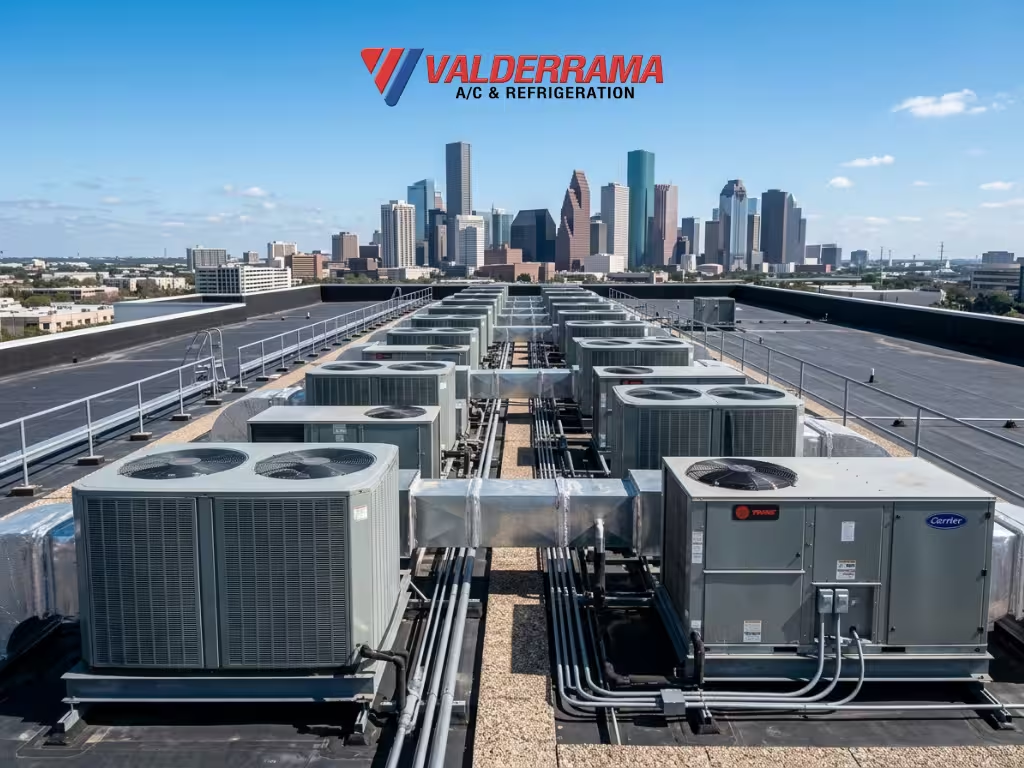
In Texas, commercial HVAC equipment is often one of a building’s hardest-working mechanical assets.
During a Houston summer, cooling equipment can operate for extended periods under high outdoor temperatures and humidity. The longer and harder equipment operates, the more important proper maintenance becomes.
Understanding the lifespan of commercial HVAC systems allows businesses to move from reactive crisis management to proactive asset planning.
At Valderrama A/C & Refrigeration, we help Texas businesses evaluate equipment condition, identify developing problems, and determine when maintenance, repair, or replacement should be considered.
The Texas Factor: Why Local Climate Can Affect Longevity
If you look at a manufacturer’s literature, you’ll often find an expected service life or warranty period.
But real-world commercial HVAC lifespan depends on the environment in which the equipment operates.
Texas presents several challenges, particularly in the Greater Houston area.
Heat Stress and Duty Cycles
Commercial HVAC systems in Houston may operate for long periods during the cooling season.
Outdoor temperatures can remain extremely high, while indoor spaces continue to generate heat from:
- Employees
- Computers
- Lighting
- Machinery
- Refrigeration equipment
- Commercial cooking
- Doors opening and closing
- Solar heat gain
The HVAC system must continually remove this heat.
Extended operating hours don’t automatically mean equipment will fail early, but they increase the importance of proper sizing, airflow, coil cleanliness, electrical condition, lubrication where applicable, and preventive maintenance.
Compressors, motors, bearings, belts, electrical components, and controls can all experience additional wear when equipment operates heavily.
Humidity and Corrosion
Houston’s humidity presents another challenge.
Moisture can contribute to corrosion of equipment components, especially when combined with contaminants, standing water, poor drainage, or coastal conditions.
Businesses closer to the Gulf Coast can also experience exposure to salt-laden air.
Salt and moisture can accelerate corrosion of outdoor coils and other metal components.
However, there is no universal rule that says coastal exposure will reduce HVAC life by exactly 30%. Actual impact depends on distance from the coast, equipment location, maintenance, materials, protective coatings, environmental exposure, and other factors.
For facilities in coastal or highly corrosive environments, preventive inspections and appropriate corrosion-control measures can be particularly important.
5 Signs Your Commercial HVAC Is Reaching Its Limit
If your equipment is approaching or exceeding its expected service-life range, keep an eye out for these warning signs.
1. Rising Energy Intensity
If utility consumption is increasing despite relatively stable occupancy, production, and operating schedules, declining HVAC efficiency may be one possible cause.
Dirty coils, clogged filters, failing motors, refrigerant problems, duct leakage, poor controls, and aging equipment can all contribute to increased energy consumption.
Rather than looking only at the total utility bill, facility managers can monitor energy use relative to building occupancy or operating conditions.
This provides a more useful picture of whether HVAC performance is changing.
2. Frequent Component Failures
One failed component doesn’t necessarily mean an HVAC system has reached the end of its useful life.
But repeated failures can be a different story.
If you’ve recently replaced several components such as:
- Fan motors
- Capacitors
- Contactors
- Sensors
- Belts
- Control boards
- Compressors
- Actuators
the cumulative repair cost deserves attention.
A system that requires increasingly frequent repairs may warrant a replacement evaluation even if it continues to operate.
3. Humidity Management Issues
The building feels sticky, musty, or uncomfortable even though the thermostat says the temperature is correct.
This can indicate a problem with the HVAC system’s ability to manage moisture.
Possible causes include:
- Oversized equipment
- Short cycling
- Poor airflow
- Dirty coils
- Refrigerant problems
- Inadequate ventilation control
- Building-envelope issues
- Drainage problems
Humidity problems shouldn’t automatically be blamed on an aging unit, but persistent moisture issues deserve investigation.
4. Noisy Operation
New or increasingly loud noises can indicate mechanical problems.
Watch for:
- Grinding
- Squealing
- Rattling
- Excessive vibration
- Repeated banging
- Unusual compressor sounds
These symptoms can be associated with worn bearings, loose components, damaged belts, fan problems, or other mechanical issues.
Early diagnosis may allow a relatively small repair to be completed before it becomes a major equipment failure.
5. Refrigerant Obsolescence
Some older commercial systems still operate using R-22, also known as HCFC-22.
R-22 is no longer produced or imported in the United States for normal servicing purposes. However, existing R-22 systems are not automatically required to be replaced. Existing equipment can continue to be serviced using legally available recovered or reclaimed R-22.
The important issue for a business is long-term planning.
As older R-22 equipment ages, businesses should consider the availability and cost of refrigerant, leak history, repair requirements, energy performance, and replacement options.
EPA specifically recommends considering repair-or-replace options as R-22 supplies become more limited and potentially more expensive.
Breakdown of Expected Lifespans by Equipment Type
Commercial HVAC is a broad category.
The expected lifespan of commercial HVAC systems varies considerably depending on equipment design, operating conditions, maintenance, and application.
The following ranges should be treated as planning guidelines rather than guaranteed service lives:
| Equipment Type | Typical Planning Range | Primary Wear Factors |
| Rooftop Units (RTUs) | 15–20 Years | Long operating hours, heat, weather exposure, coils, compressors, motors |
| Commercial Split Systems | 15–20 Years | Operating hours, condenser exposure, maintenance, airflow |
| VRF Systems | 15–20+ Years | Compressor operation, controls, maintenance, operating environment |
| Commercial Chillers | 20–25+ Years | Water quality, scaling, corrosion, compressor condition, maintenance |
| Commercial Boilers | 20–30+ Years | Corrosion, water quality, pressure, combustion, maintenance |
These are not hard expiration dates. ASHRAE maintains a service-life database covering tens of thousands of HVAC equipment records, demonstrating that actual service life varies by equipment type, building, environment, and other conditions.
For example, ASHRAE notes that manufacturers of air-source VRF systems commonly list approximately 15–20 years as an average life-expectancy range, while water-source VRF systems can have longer expected ranges.
Why Your Facility’s Operating Hours Matter
A retail store open 10 hours per day has a different HVAC duty cycle from a manufacturing facility operating around the clock.
Similarly, a warehouse with large loading doors may have very different cooling demands from a climate-controlled office.
When estimating equipment life, consider:
- Hours of operation
- Seasonal load
- Occupancy
- Indoor heat generation
- Outdoor exposure
- Maintenance history
- Equipment age
- Previous repairs
- Environmental conditions
That’s why a single number shouldn’t be used to determine whether every commercial HVAC system is ready for replacement.
How to Maximize the Life of Your Business Units
You don’t have to accept premature equipment failure as a fact of doing business in Texas.
Proactive maintenance can help identify problems before they become major failures and can help equipment operate closer to its intended performance.
The Power of Preventive Maintenance
A neglected HVAC system often has to work harder to deliver the same amount of cooling.
Dirty coils reduce heat transfer.
Dirty filters restrict airflow.
Loose electrical connections can create electrical problems.
Worn belts can reduce fan performance.
Poorly maintained condensate systems can create drainage issues.
Small problems can eventually contribute to larger failures.
A commercial preventive-maintenance program can include tasks such as:
- Filter replacement
- Coil inspection and cleaning
- Condensate-drain inspection
- Electrical inspection
- Belt inspection and adjustment
- Motor inspection
- Refrigerant-system checks
- Thermostat and control checks
- Airflow verification
- Safety-control testing
- Equipment performance evaluation
The exact maintenance schedule should be based on equipment type, manufacturer recommendations, operating environment, and facility needs.
Advanced 2026 Monitoring
Modern commercial facilities can also use connected sensors and building automation systems to monitor HVAC performance.
Depending on the system, building managers can monitor information such as:
- Temperature
- Humidity
- Runtime
- Equipment alarms
- Pressure
- Energy consumption
- Setpoints
- Occupancy schedules
- Equipment status
This can make it easier to identify unusual operating patterns.
For example, if one rooftop unit suddenly begins running significantly longer than comparable units serving similar spaces, that difference can trigger an investigation before the system experiences a complete failure.
Building automation and remote monitoring don’t eliminate the need for physical maintenance, but they can provide another layer of information for facility management.
Maintaining Proper Airflow
Airflow is one of the most important factors in commercial HVAC performance.
Dirty filters, blocked returns, damaged ductwork, closed dampers, dirty coils, or poorly balanced systems can all affect airflow.
Excessive static pressure can also place unnecessary demand on blower systems.
A professional commercial HVAC technician can measure and evaluate airflow and static pressure rather than relying only on whether air appears to be coming from the registers.
To ensure your facility is operating reliably and efficiently, we recommend exploring our commercial HVAC maintenance service designed around your building and equipment.
Energy Efficiency: Don’t Confuse Age With Performance
An older commercial HVAC system isn’t automatically inefficient, just as a new system isn’t automatically the most economical choice for every facility.
The right comparison should include the entire lifecycle cost.
Consider:
- Purchase price
- Installation cost
- Expected energy consumption
- Maintenance requirements
- Repair history
- Equipment lifespan
- Downtime risk
- Available controls
- Warranty
- Building operating schedule
Understanding 2026 Efficiency Standards
It’s also important not to describe all commercial equipment using residential SEER2 terminology.
For larger commercial packaged air conditioners and heat pumps, DOE regulations commonly use metrics such as EER and IEER. DOE has established amended federal energy-conservation standards for certain air-cooled commercial packaged equipment rated at 65,000 Btu/h and above, with compliance for those amended standards beginning January 1, 2029, rather than 2026.
That means a Texas business replacing equipment in 2026 should evaluate the specific equipment category, applicable efficiency requirements, refrigerant requirements, local code considerations, and the manufacturer’s current product specifications.
Instead of simply asking for a “SEER2-compliant commercial unit,” ask your HVAC contractor:
“What efficiency rating applies to this equipment category, and what current federal and local requirements apply to the installation?”
That question is much more useful for a commercial facility.
Why Professional Commercial Service Matters
Commercial HVAC systems are complex mechanical and electrical systems.
They aren’t simply “big residential units.”
Depending on the facility, commercial HVAC may involve:
- Three-phase electrical power
- Large compressors
- High-capacity blower assemblies
- Economizers
- Variable-frequency drives
- Building automation
- Multiple stages of cooling
- Refrigerant controls
- Commercial ventilation
- Rooftop equipment
- Chillers
- Boilers
- VRF systems
- Complex zoning
A professional commercial HVAC service program can help identify developing problems while maintaining equipment according to manufacturer requirements.
Documentation Matters
For facility managers, maintenance documentation is just as important as the maintenance itself.
Keep records of:
- Service dates
- Repairs
- Parts replaced
- Refrigerant work
- Filter changes
- Coil cleaning
- Electrical repairs
- Equipment inspections
- Energy-performance changes
- Warranty information
A detailed maintenance history makes future repair-or-replace decisions much easier.
It also gives a new facility manager or contractor valuable information when diagnosing an older system.
Repair vs. Replace: A Better Commercial Decision
The decision to repair or replace a commercial HVAC unit shouldn’t rely on one simple formula.
The commonly referenced “50% rule” can be a useful conversation starter, but it is not a universal engineering or financial rule.
Instead, consider the complete picture.
Repair May Make Sense When:
- The equipment is relatively young.
- The repair is minor.
- The system has a good maintenance history.
- Major components are in good condition.
- Parts are readily available.
- Efficiency remains acceptable.
- There is no significant refrigerant or controls issue.
Replacement May Deserve Consideration When:
- Major components are repeatedly failing.
- Repair costs are increasing.
- The system has frequent downtime.
- Energy consumption is rising.
- The equipment is approaching the end of its expected service life.
- Refrigerant availability is becoming a concern.
- The system cannot maintain required temperature or humidity.
- Replacement parts are becoming difficult to source.
- A new system would substantially improve operational efficiency.
For a commercial facility, downtime risk can be just as important as the equipment’s purchase price.
A business that loses several hours of operation because of an HVAC failure may incur costs far beyond the repair invoice.
FAQ: Commercial System Longevity
Q: What is the lifespan of commercial HVAC systems?
A: Many commercial HVAC systems have a planning life of approximately 15–20 years, but actual service life varies considerably by equipment type, operating hours, climate, installation quality, and maintenance. Some chillers, boilers, and other systems can have longer service lives when properly maintained.
Q: Is it better to repair a 12-year-old unit or replace it?
A: Age alone doesn’t determine the answer. Consider the repair cost, equipment condition, repair history, energy consumption, parts availability, downtime risk, and expected remaining service life. A professional assessment can help compare the cost of continued operation with replacement.
Q: Does a Building Automation System (BAS) help units last longer?
A: A BAS can help operators monitor equipment, control schedules, reduce unnecessary runtime, identify abnormal operation, and improve building control. It does not replace physical maintenance, but better monitoring and scheduling can help reduce unnecessary operation and identify problems earlier.
Q: How often should commercial HVAC equipment be serviced?
A: The appropriate schedule depends on the equipment, operating hours, environment, manufacturer recommendations, and facility requirements. Many commercial facilities benefit from scheduled preventive maintenance rather than waiting for equipment to fail. High-use or demanding environments may require more frequent inspections.
Q: Can regular maintenance double the lifespan of a commercial HVAC system?
A: There is no reliable universal multiplier such as “maintenance doubles equipment life.” Preventive maintenance can help reduce avoidable wear, maintain performance, identify problems early, and potentially extend useful service life, but every system and operating environment is different.
Secure Your Business Future
Instead of waiting for a rooftop unit to fail during the hottest week of the year, you can monitor its condition, track repair costs, review energy performance, and budget for replacement before the equipment becomes an emergency.
At Valderrama A/C & Refrigeration, we provide commercial HVAC service for Texas businesses with a focus on reliable operation, preventive maintenance, repairs, and long-term equipment planning.
We’ll help you understand the condition of your existing equipment and determine whether maintenance, repair, or replacement makes the most sense for your facility.
Ready for a comprehensive facility HVAC evaluation?
Schedule Your Commercial HVAC Asset Evaluation Today!
Call Valderrama A/C & Refrigeration at (281) 974-4599 to discuss a custom commercial HVAC maintenance plan for your Texas business.